



Maximizing Space Efficiency with Curved Workstation Layouts
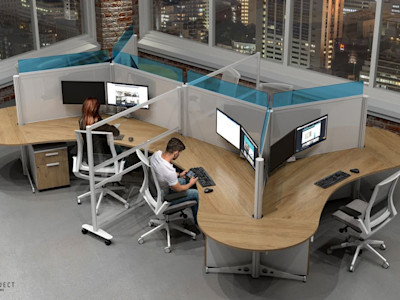
Office design has evolved far beyond rows of bulky cubicles and rigid desk arrangements. Today’s workplaces are expected to do more with less space while still supporting employee comfort, collaboration, privacy, and productivity. Businesses are searching for office solutions that feel modern and flexible without sacrificing functionality. That’s where curved workstation layouts have become a game changer.
Curved modern workstations offer a fresh approach to office design by helping organizations maximize usable square footage while creating work environments that feel more open, intentional, and efficient. Unlike traditional straight-line workstation layouts that can make offices feel boxed in and repetitive, curved workstations introduce flow, flexibility, and smarter use of floorplans.
For growing companies, hybrid work environments, and offices navigating limited square footage, curved workstation layouts provide a practical solution that balances space-saving design, privacy, and day-to-day functionality.
Modern modular workstations are designed to optimize space while supporting productivity, creativity, and safe collaboration in today’s workplace environments.
Why Traditional Workstation Layouts Often Waste Space

Traditional workstation configurations typically rely on long rows of rectangular desks and hard 90-degree angles. While these layouts once dominated office design, they often create inefficient gaps, awkward walkways, and underutilized corners.
In many offices, straight workstation groupings leave dead space between departments or force employees into cramped layouts that prioritize quantity over comfort. The result is a workspace that feels crowded despite not fully utilizing available square footage.
Curved workstation layouts solve this problem by softening the geometry of the office. Instead of forcing movement and furniture into rigid lines, curved configurations naturally guide traffic flow and create more adaptable workstation groupings.
This becomes especially valuable in offices with unconventional floorplans, shared collaborative areas, or hybrid work environments where flexibility matters. Curved layouts allow designers to fit more functional workstations into a space without making the office feel overcrowded.
Modern modular workstation systems also allow businesses to scale and reconfigure layouts as teams grow. Modular workstation components can be customized and adapted to fit changing office needs and maximize floorplan efficiency.
Space Saving Without Sacrificing Comfort

One of the biggest misconceptions about space-efficient office design is that it requires employees to give up comfort or personal workspace. Curved workstation layouts prove that offices can save space while still creating an environment employees enjoy working in.
Because curved desks and modular configurations fit together more organically, they reduce wasted transitional space between workstations. This allows offices to maintain comfortable working areas while improving overall density in a more natural way.
Curved workstation clusters also make it easier to create designated pathways and collaborative zones without interrupting workflow. Employees have enough room to move comfortably while organizations gain better control over how space is allocated throughout the office.
In open office environments, this balance is critical. Companies want to support collaboration while still ensuring employees have enough personal space to focus. Curved layouts create visual separation between workers without requiring large physical barriers that consume additional square footage.
Our modular workstation systems are specifically designed to optimize office layouts while supporting productivity and workplace flexibility. Their modern cubicle and workstation solutions allow businesses to customize configurations to fit both spatial needs and employee preferences.
The Privacy Advantage of Curved Workstations

Privacy remains one of the biggest challenges in modern office design. While open offices encourage communication, they can also create distractions, noise issues, and a lack of personal space.
Curved workstation layouts help solve this problem by naturally creating separation between employees without making the office feel closed off. The shape of the workstation itself introduces subtle visual barriers that improve focus while maintaining an open, modern aesthetic.
Many curved workstation systems also incorporate acoustic panels, privacy screens, and divider options that further enhance concentration and reduce distractions. These features help employees feel more comfortable and supported throughout the workday.
Our curved workstation solutions include privacy-focused designs with customizable shielding and divider heights to accommodate different levels of privacy and collaboration. Some workstation systems feature acoustic felt dividers, acrylic screens, and cleanable surfaces that enhance both functionality and employee well-being.
Privacy has become even more important in hybrid workplaces where employees may alternate between remote and in-office work. When workers come into the office, they expect spaces that support focused work as much as collaboration. Curved workstation layouts help organizations create environments that feel productive instead of chaotic.
The ability to customize privacy levels also allows businesses to tailor workstation layouts to different departments. Creative teams may benefit from more open curved configurations, while finance, HR, or customer service teams may require greater acoustic separation and shielding.
Creating Better Workflow and Traffic Flow

Another major advantage of curved workstation layouts is how they improve movement throughout the office. Traditional rows of desks can create narrow pathways and awkward bottlenecks that disrupt productivity and make offices feel crowded.
Curved layouts encourage smoother traffic flow by guiding movement more naturally through the workspace. Employees can navigate the office more comfortably, and collaborative areas can be integrated more seamlessly into the overall design.
This is especially beneficial in high-density office environments where maximizing usable space is essential. Instead of dedicating large sections of the office to wide walkways or oversized corridors, curved workstation designs help create efficient circulation patterns that support both movement and functionality.
The result is an office that feels more spacious, even when accommodating the same number of employees.
Curved workstation layouts also improve sightlines throughout the office. Employees can maintain a sense of openness and connection while still benefiting from personal workspace boundaries. This balance helps offices feel less rigid and more welcoming overall.
Supporting Hybrid and Flexible Work Environments

Modern workplaces are changing rapidly, and office furniture must adapt accordingly. Hybrid work has created a growing demand for office layouts that support flexibility, collaboration, and evolving team structures.
Curved modular workstations are ideal for these environments because they can be reconfigured as organizational needs change. Businesses can expand workstation groupings, create touchdown spaces, or redesign collaborative areas without completely replacing their furniture systems.
We know the value of modular office furniture in helping businesses remain agile and adaptable as workplace needs evolve. Their workstation solutions are designed to support changing layouts, hybrid workflows, and future growth.
This adaptability also helps organizations maximize long-term value from their office furniture investments. Instead of redesigning an office every few years, modular curved workstation systems can evolve alongside the business.
For companies managing fluctuating in-office attendance, flexible workstation configurations help create offices that feel intentional rather than half-empty or overcrowded. Teams can easily adjust layouts based on daily needs, collaborative sessions, or department growth.
Functionality Beyond the Desk
Today’s workstations are expected to do far more than simply hold a computer. Employees need integrated storage, technology access, ergonomic support, and adaptable work surfaces that support different work styles throughout the day.
Modern curved workstation systems are designed with these needs in mind. Many include integrated cable management, monitor arms, storage solutions, power access, acoustic materials, and sit-stand capabilities that improve both organization and employee comfort.
Our workstation offerings include ergonomic monitor arms, desktop power and USB charging capabilities, acoustic dividers, and customizable storage options that enhance both usability and workspace efficiency.
Functionality is particularly important in smaller office footprints where every piece of furniture must serve multiple purposes. Curved workstation layouts allow organizations to integrate storage, collaboration, and privacy solutions into a single cohesive design rather than relying on separate furniture pieces that consume additional space.
This creates cleaner, more organized work environments that support productivity while maintaining a modern aesthetic.
Designing an Office Employees Want to Use

Office design directly impacts how employees feel about their work environment. Spaces that feel cramped, noisy, or disconnected can negatively affect morale and productivity. On the other hand, thoughtfully designed offices encourage engagement, focus, and collaboration.
Curved workstation layouts help create offices that feel more inviting and human-centered. The softer lines and flowing configurations create a more dynamic atmosphere compared to rigid cubicle rows.
Modern workstations are designed to inspire productivity, creativity, and collaboration while helping organizations create workplaces employees want to “escape to, not from.”
By combining space efficiency with privacy and functionality, curved workstation layouts help businesses create environments that support both employee well-being and operational efficiency.
This matters not only for day-to-day productivity but also for recruitment and retention. Employees increasingly expect workplaces that reflect modern work styles and prioritize comfort, flexibility, and thoughtful design.
The Future of Space-Efficient Office Design
As organizations continue to rethink how office spaces are used, flexibility and efficiency will remain top priorities. Businesses need furniture systems that maximize square footage while supporting changing work styles, employee expectations, and long-term adaptability.
Curved workstation layouts represent a smarter approach to modern office design because they solve multiple challenges at once. They improve space utilization, enhance privacy, support functionality, and create more visually engaging environments.
Rather than forcing offices into rigid layouts that waste valuable space, curved modular workstations allow organizations to design workplaces that feel intentional, adaptable, and future-ready.
For companies looking to optimize their office footprint without sacrificing comfort or productivity, curved workstation layouts offer a practical and modern solution that supports the evolving needs of today’s workplace.
Want to learn more about modern office trends? Take a look at other posts from the StrongProject Blog:


